
Pre-Submission Peer Review: Why it Matters and How it Works
That research paper of yours has gone through multiple revisions and is waiting to be submitted. Yet, there’s something holding you back.
“What if it gets rejected in the peer review process?”
“Does my paper meet the quality sought by top peer-reviewed journals?”
If these doubts bother you, know that there’s a simple solution in the name of pre-submission peer review! But how does it work exactly? And what should authors look for before opting for a pre-submission peer review service? Here’s everything you need to know.
Peer Review Process: An Overview
What is Pre-Submission Peer Review
How Pre-Submission Peer Review Works
Benefits of Pre-Submission Peer Review
Peer Review Process: An Overview
First, let’s briefly understand how the peer review process works. When you submit a research paper to your preferred journal, it undergoes an initial screening by the editor-in-chief of the journal. Once the paper is deemed suitable for peer review, it is sent for a thorough evaluation by experts in the field.
The research is reviewed and evaluated for its novelty, originality, and impact in addition to being checked for grammar and accuracy. Based on their evaluations, peer reviewers provide detailed feedback to the journal’s editor, who then determines whether the paper should be accepted with major/minor revisions or rejected.
The authors must then rework their manuscript based on the reviewer comments and respond to each of them after making the necessary changes. The resubmitted manuscript is reviewed again and accepted for publication depending on the journal editor’s decision.
Here’s a complete guide for the step-by-step peer review process and the different types of peer reviews followed by journals and publications.
What is Pre-Submission Peer Review
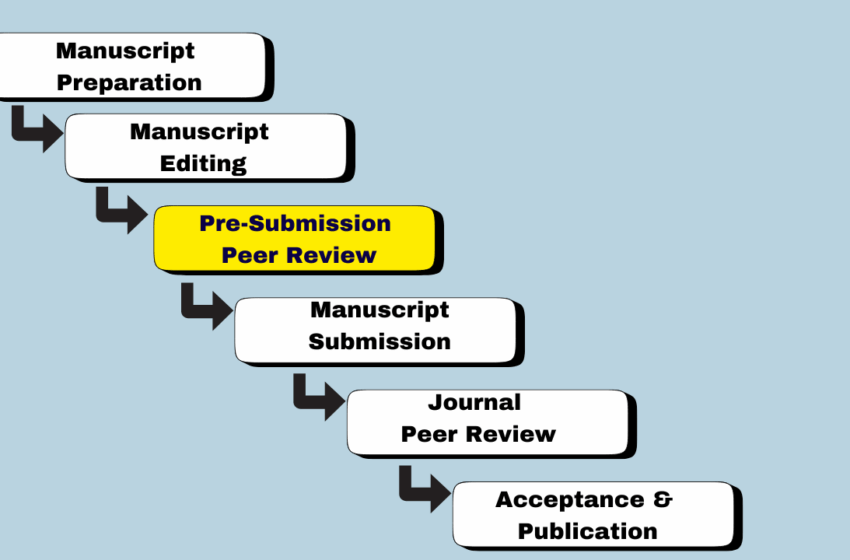
Think of pre-submission peer review as a “pre-review” process. Your paper undergoes a mock peer review by experienced experts before the actual journal peer review.
The purpose of a pre-submission peer review is to help authors identify the flaws in their manuscript from the eyes of a journal editor or a peer reviewer. The manuscript can then be edited to enhance its quality, such that there’s a higher possibility of acceptance with minimal revisions.
How Pre-Submission Peer Review Works
Pre-submission peer review is more than having your colleagues peruse your research paper for you. You need the eyes of an experienced journal editor or a peer reviewer to know what your target journal expects and how the quality of your manuscript can be improved to meet those standards.
This is how a typical pre-submission peer review would work:
- You submit your research paper to a service provider informing them of the necessary guidelines and instructions they need to follow. For instance, provide them with your target journal or a list of preferred journals so they can evaluate your manuscript accordingly. You may also specify which subject area is the primary focus of your study so that the right subject matter experts can be identified for evaluating your manuscript.
- Your manuscript is then subjected to a thorough technical review. The research paper is checked for any flaws in the logical presentation, coherence, inconsistencies in data, ethical compliances, and enhancements required in terms of vocabulary, language, and grammar accuracy.
- A feedback report is prepared followed by this evaluation, outlining recommendations and action points for manuscript enhancement. As authors, you can determine which of the suggestions you wish to implement. For instance, a reviewer may recommend modifying the title with a different phrasing that captures the attention of journal editors. However, if it does not suit your intent, you may choose not to make the suggested changes. In fact, you may even provide your own suggestion for an alternative title and check with the expert evaluators again.
- This brings us to multiple rounds of peer review evaluations. Pre-submission peer review gives you an opportunity to have your manuscript rechecked by experts after you have made the suggested changes. This means that your final submission can be refined to maximize the chances of receiving a positive response from your target journal.
Benefits of Pre-Submission Peer Review
Writing a research paper anticipating publication and then receiving negative feedback can be distressing. So, why not minimize the chances of rejection by ensuring a high-quality submission?
Having experienced journal editors and peer reviewers evaluate your manuscript before the final submission has several benefits.
1. Faster publication: You might have a well-structured manuscript that presents sound research findings. However, a pre-submission peer review provides a comprehensive and objective evaluation of your manuscript, helping you identify technical gaps. Recognizing these gaps at an early stage is crucial as it helps you make corrections sooner. Submitting a technically accurate and logically structured manuscript gives peer reviewers less opportunity for criticizing your work. With fewer criticisms, your response to peer reviewer comments can be faster, thus contributing to rapid publication.
2. Comprehensive constructive feedback: In a pre-submission peer review, you have subject experts who offer constructive feedback through a detailed assessment of your paper. They gauge the scientific content by going beyond language checking, recognizing areas of improvement from a peer reviewer’s perspective. This feedback report highlights essential improvements for your paper that an actual peer reviewer is likely to check. So, implement the suggestions provided to enhance the content of your paper to meet the quality standards of top journals.
3. Multiple rounds of review: With an actual peer review, you only get one chance to respond to comments. But in a pre-submission peer review, you can discuss with the experts over multiple rounds of technical reviews until your manuscript is polished to your satisfaction.
For instance, if you disagree with a specific suggestion mentioned in the feedback report, you can ask for an alternative recommendation that better suits your requirements.
4. Journal compliance: Non-compliance with journal instructions—be it because of formatting issues or not aligning with journal scope—is one of the major reasons for desk rejections. Because the expert evaluators involved in the pre-submission peer review process are experienced reviewers, they provide suggestions for enhancing your manuscript to comply with all journal requirements, minimizing the chances of desk rejections.
Key Takeaway
Pre-submission peer review is an opportunity for you to experience how an actual peer review would work, helping you prepare better for responding to journal comments. A “pre-reviewed” manuscript implies that you have high-quality research submitted to your preferred journal, maximizing your chances of a rapid publication.
Want to know if your paper is ready for peer review? Get your manuscript evaluated by expert reviewers using our Pre-Submission Peer Review Service.









Q&As about peer review- 5 hot topics...
September 20, 2024