Work-Life Balance in Academia: Time-Management Strategies for Researchers
Recently, there has been a global uprising against the “996” work culture, which was once popular in the tech industry1. This idea of working from 9 AM to 9 PM 6 days a week meant a 72-hour work week, with little to no time left for personal life!
Researchers are not entirely new to this concept. As students, you must have worked late hours in the lab or in your dormitory, focused on finishing your reports and dissertation. You might have even survived on large mugs of coffee and bite-sized snacks because eating a full meal would simply consume too much time! While this lifestyle churns out short term results, it is not sustainable in the long run. And so, this blog will guide you towards a more balanced life by helping you understand how to prioritize tasks, manage boundaries, and embrace flexibility by implementing effective time-management strategies.
Challenges Faced by Researchers
Balancing Personal and Professional Priorities
Setting Boundaries and Embracing Flexibility
Work-Life Harmony
There’s always disagreement on how work-life balance is defined. Is it juggling between your professional and personal life? Or should it be a well-choreographed performance?
Essentially, work-life harmony is experiencing fulfillment by optimally integrating various aspects of both professional and personal lifestyles. Think of it as being able to achieve your career aspirations without compromising on your personal well-being. Sounds like a dream, eh? That’s because all researchers have felt burdened by their work at some point in their life.
The irony is that researchers often experience a lack of clarity in thinking because of this stress. Yet, the ability to think clearly is the most crucial aspect of a researcher’s work! So, instead of suffering from burnout and losing the ability to think critically and creatively, researchers need to learn how to strengthen relationships, improve mental and physical health, and enhance job performance to enjoy a satisfactory life.
Remember, the long career ahead of you is a marathon and not a sprint! And research as a career is highly demanding, and you are bound to come across challenges.
Challenges Faced by Researchers
There are occasions that test a researcher’s frustration levels. And why shouldn’t it? A researcher’s job is to explore unchartered territories with every new project they take up. Projects may proceed a lot slower than anticipated or ultimately remain incomplete. There may be many failed experiments, and there’s always the added pressure to perform and publish in this highly competitive field!
All this impacts a researcher’s personal time, sometimes without them realizing it. While spending time with their colleagues and peers working in the lab, researchers deprioritize their family and friends. There may not be enough time to pursue hobbies or other interests outside of research work. Staying away from family during holidays and festivities can make a researcher feel lonely, especially when they badly need a break. This is because science often demands long and careful deliberations, and personal time can feel like the only “quiet time.”
Therefore, it is important to identify when the “work-life imbalance” becomes the norm rather than it being a one-off occurrence. It’s always just one more experiment, one more manuscript, and one more grant application—making the list endless. However, your energy is not limitless. And eventually, you tend to run out of gas if your tank is not refueled! This impacts both your personal and professional life.
- Your close family and friends may not understand the demands of your work, leading to emotional distance. Often, a simple conversation over the phone with a loved one can boost your energy levels on a bad day at work. But without support and understanding, dealing with failures becomes challenging.
- Working in different geographical locations can be highly taxing. Researchers tend to move cities, or even countries, to advance in their academic career. Not being able to settle in one place and having to move around frequently may be frustrating for your family, which in turn impacts you.
- Personal dissatisfaction could impact professional performance. When you feel low on energy, the creative juices stop flowing and you lack the motivation to proceed.
Overall, a researcher’s life can feel like a ship sailing through a storm, with both personal and professional waves trying to pull you under while you’re struggling to stay afloat. So, how do you achieve that optimal balance between both priorities?
Balancing Personal and Professional Priorities
All decision making in life can be measured on a yardstick called “priorities,” and clear priorities let you know where you are headed. Keep in mind that identifying your personal and professional priorities requires serious introspection. But most researchers are likely to have the following goals in mind:
| Personal goals | Professional goals |
| Having a family, kids | Obtaining a PhD |
| Wanting to travel twice a year | Publishing in a reputed international journal |
| Living in another country for a certain period | Getting a tenured position at a university |
Now, to maintain that work-life harmony, you need to simultaneously work on personal and professional goals. So, try to find overlapping priorities that could favor your situation.
- For example, consider completing your postdoctoral research in a different country. Not only is this an opportunity for you to travel, but you also get to experience a different work culture that might be enlightening.
- Raising kids requires a ton of flexibility! But there will be periods where you can afford to work flexible hours without having to compromise on your career. For instance, supervising a group of students or writing a research paper by collaborating with your peers should give you more time to spend with your family.
In this way, balance your commitments by identifying what works best for you. Fundamentally, you need to focus on your mental and physical well-being to successfully navigate these priorities. And this brings us to creating healthy boundaries and accepting flexibility.
Setting Boundaries and Embracing Flexibility
Communication is key, both in your personal and professional lives. Setting boundaries means you need to be vocal about what’s important for you. At first, it might appear that you are uncooperative at your workplace. However, the better you communicate, the more understanding your peers will become.
Know when to say “NO” and do say “YES” if you are able to commit to work. You might have to say NO more often than you anticipate, both for small and big things. For example, you might be offered to do your PostDoc in a well-known laboratory, but on a topic that does not interest you. An incredible job offer that pays well may keep you on the road and away from your family. Is that something you really want for yourself? If not, both these “big things” warrant a NO from you. Similarly, small responsibilities like grading students’ exams as a favor to a colleague or reviewing research papers for a journal may not be something you can accommodate in your already packed schedule. So, it’s okay to say NO to these as well.
Tips for Effective Communication
Not all your NOs require an explanation. But in some cases, you need to justify why you are refusing a task. This can be especially challenging when communicating with a superior. So, here are some useful tips.
- Be clear and specific: Always articulate your boundaries clearly. Being ambiguous could lead to unnecessary misunderstandings. Specify details and clarify what is acceptable and what is not.
- Express feelings and reasons: Others can understand your perspective only when you share your opinions openly. Create an empathetic communication bridge so they understand and respect your limits.
- Use “I” statements: Take accountability rather than placing blame elsewhere. Say “I feel” or “I need to” so your tone does not sound accusatory.
- Propose alternatives: Denying your supervisors of your assistance may not always be feasible. But clearly communicate how much responsibility you can take. For instance, if additional work is requested, ask them which of your current tasks should be deprioritized. If there’s a demand for a change of focus, set reasonable expectations at the beginning by keeping in mind your available bandwidth.
How to Manage Flexibility
Following an extremely rigid schedule could impact both your professional and personal lifestyles. Choosing flexibility comes with unique benefits, and integrating your personal and professional priorities creates a good synergy.
For instance, if you are just starting a family and need to spend valuable time with them, do not commit to a job that requires you to travel frequently. If you want to publish in a highly competitive international journal, do this at a time when your personal priorities are fewer. When you get an opportunity to live abroad, make sure your family is on board and choose a place that’s acceptable to all!
Flexibility also leads to better mental health, which in turn contributes to remaining consistent in your work. It enables you to think differently, and you will find that adapting to new research strategies comes quite easily when working on a project. Another advantage of being flexible is your improved chances of collaborating with researchers in various parts of the world. For instance, moving your start and end time at the laboratory lets you work with peers from various time zones with the aid of technology.
However, flexibility comes with certain challenges:
- There could be communication barriers that could potentially lead to delays and extremely tight deadlines.
- Tracking progress while distributing accountability may be challenging when researchers have autonomy over their schedules.
- Coordinating meetings, sharing updates, and addressing urgent issues could become difficult.
But these can be overcome by implementing a few good practices:
- Structured project management: Set a robust structure for managing your project by consulting key team members. Set flexible yet clear schedules accounting for expectations and deadlines.
- Pre-established communication norms: Decide how often you will meet and follow a set frequency for communicating updates. Give your team members feasible response times and promote an environment of shared understanding.
- Regular assessments: Have regular check-ins and assess the workload distribution among team members. If you feel overburdened, communicate this with the team and formulate realistic timelines for deliverables.
Occasionally, be open to accommodating others’ responsibilities during emergencies. Strategizing your team’s work distribution and prioritizing activities fosters a healthy work environment.
Time-Management Strategies
But all these suggestions work only with effective time-management strategies. It takes meticulous planning to successfully execute your well-defined strategies by balancing the allocation of time and focusing on the right priorities so that you can operate with reduced stress. So, here are some prioritization techniques and fundamental strategies that can help you manage your time well.
1. The big rocks, small rocks strategy
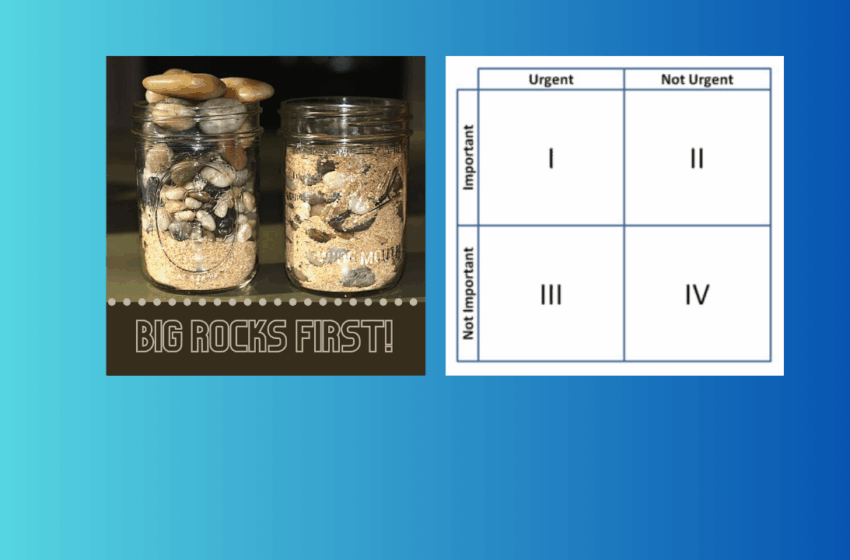
This is a basic prioritization technique. Imagine an empty glass jar that needs to be filled with different sized rocks and granules. If you start with the granules and small rocks first, you will find that many big rocks remain outside the jar. Likewise, if you prioritize the wrong tasks first, you will have several important tasks that end up being ignored or becoming “urgent,” causing stress as you attempt to fit them in your schedule.

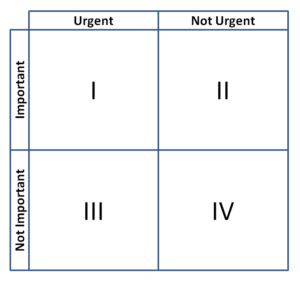
2. The 4-sqaure prioritization framework
This is a commonly used method to help prioritize your tasks better. Divide your life tasks into 4 categories: “important and urgent,” “important but not urgent,” “urgent but not important,” and “not important and not urgent.” Prepare a framework at the beginning of every month or every week and divide your tasks accordingly. Create room for important tasks (which represent the “big rocks”) and plan them first. Then, have some buffer to handle the other important but not urgent and urgent but not important tasks as well (these are the “small rocks” and “granules”).
This framework can be implemented to prioritize your professional and personal goals as well!
3. Time blocking strategy
When planning your day-to-day activities, set pre-decided time slots for each activity. Start by preparing a to-do list and allot specific periods to complete the activities.
- Examples for research work
a)9:00AM to 12:00 PM – Dedicated time for focused research on a project.
b)2:00 PM to 4:00 PM – Time block for data analysis and literature review. - Examples for personal activities
a)Morning 30 to 45 min– Allot time for personal skill development or relevant reading.
b)Evening 6:00 PM to 8:00 PM – Reserve for personal activities, exercise, or family time.
Summary
A researcher’s life can feel overwhelming at times, and some amount of stress, like a deadline, may keep you motivated and increase productivity. However, do not let stress take over your creativity and critical thinking skills. Once you get clarity on your professional and personal priorities, set boundaries and find that optimal harmony for a well-balanced life.
References
1. 996 work culture https://www.reuters.com/sustainability/society-equity/china-tries-call-time-its-996-culture-long-hours–ecmii-2025-09-01/